


APCC News
The APEC Climate Center and the National Center for Meteorological Supercomputer Constructed Korea’s First Science DMZ Network Architecture to Handle High Volume Data Transfers
- Writer
- Admin
- Date
- 2018.06.18
- Views
- 706
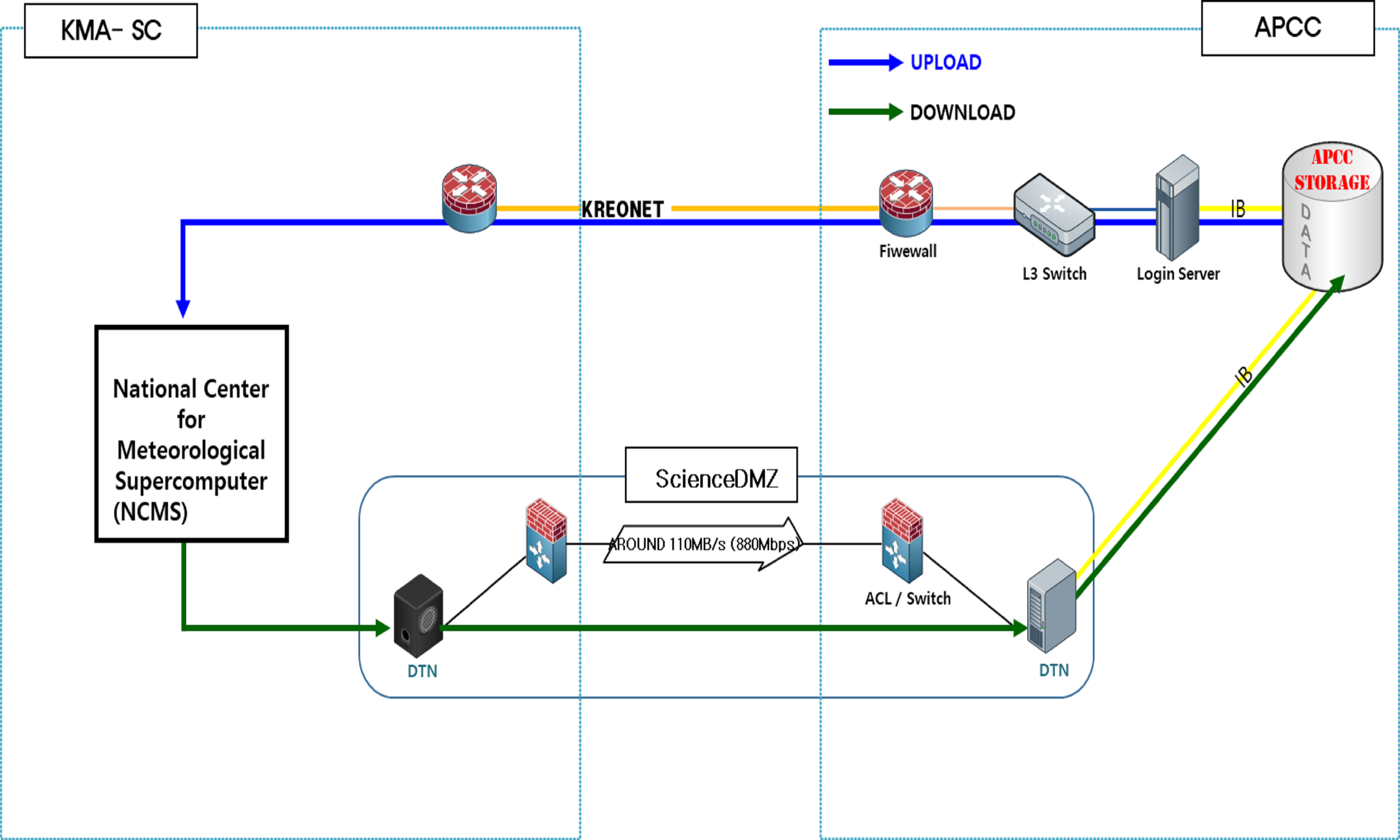
The APEC Climate Center (APCC) and the National Center for Meteorological Supercomputer (NCMS) constructed Korea’s First Science DMZ network architecture.
The Science DMZ network architecture handles high volume meteorological and climate data transfers between APCC and NCMS through Korea Research Environment Open NETwork (KREONET), operated by the Korea Institute of Science and Technological Information (KISTI).
The Science DMZ is designed to handle high volume data transfers, as is typical with scientific and high-performance computing, by creating a special DMZ to accommodate those transfers. It will be deployed at or near the local network perimeter, and is optimized for a moderate number of high-speed flows.
A firewall must restrict access to the internal network but still allow external access to services offered to the public, such as web servers on the internal network. This is accomplished by creating a separate internal network called a DMZ, a play on the term “demilitarized zone". External devices are allowed to access devices in the DMZ. Devices in the DMZ are usually maintained more carefully to reduce their vulnerability to malware.
The Science DMZ takes the DMZ idea one step farther by moving high performance computing into its own DMZ. Specially configured routers pass science data directly between designated devices on an internal network, thereby creating a virtual DMZ. Security is maintained by setting access control lists (ACLs) in the routers to only allow traffic between specific sources and destinations.
Security is further enhanced by using an intrusion detection system (IDS) to monitor traffic, and look for indications of attack. When an attack is detected, the IDS can automatically update router tables, resulting in what some call a Remotely Triggered BlackHole (RTBH).[1]
The Science DMZ network architecture has become one of the most important (indispensable) computer network designs for joint research among agencies in areas such as astrophysics and climate science where an enormous amount of data has to be created and handled.
NCMS currently carries out various calculations of climatic data through KREONET and provides APCC with high volume climate data. APCC uses high volume climate data transferred from NCMS for its real-time seasonal forecast.
APCC can produce more reliable climate forecast information by using this high-volume data from NCMS for the Seamless Coupled Prediction System (SCoPS) model, a newly developed seasonal forecast model by APCC and the University of Hawaii.
The Science DMZ Network Architecture allows APCC and NCMS to exchange multi- Terabyte (TB) data or more at the high transmission rate (efficiency of 95% or more in a 1 gigabyte network) in a day. The data transmission rate was enhanced by 100 times when compared to the previous rate.